AI events have moved far beyond the technology-conference side stage. In 2026, they form a global industry where enterprises evaluate vendors, governments shape AI policy, researchers build international networks, and emerging markets develop their own technical capabilities.
The new State of the Global AI Events Industry 2026 report analyzes 9,918 scheduled AI events, 5,443 organizers, and six major regional markets. The findings reveal an industry that is larger, more physical, more geographically distributed, and more strategically important than conventional conference counts suggest.
The report identifies 9,918 individual AI events organized by 5,443 distinct organizations. This is approximately five times the volume commonly reflected in formal conference directories.
The market is also overwhelmingly physical: 83.3% of events with a declared format are in person, while fewer than 1% use a hybrid format. At the same time, agentic AI has become the dominant technical trend, appearing in more than 10% of all event titles.
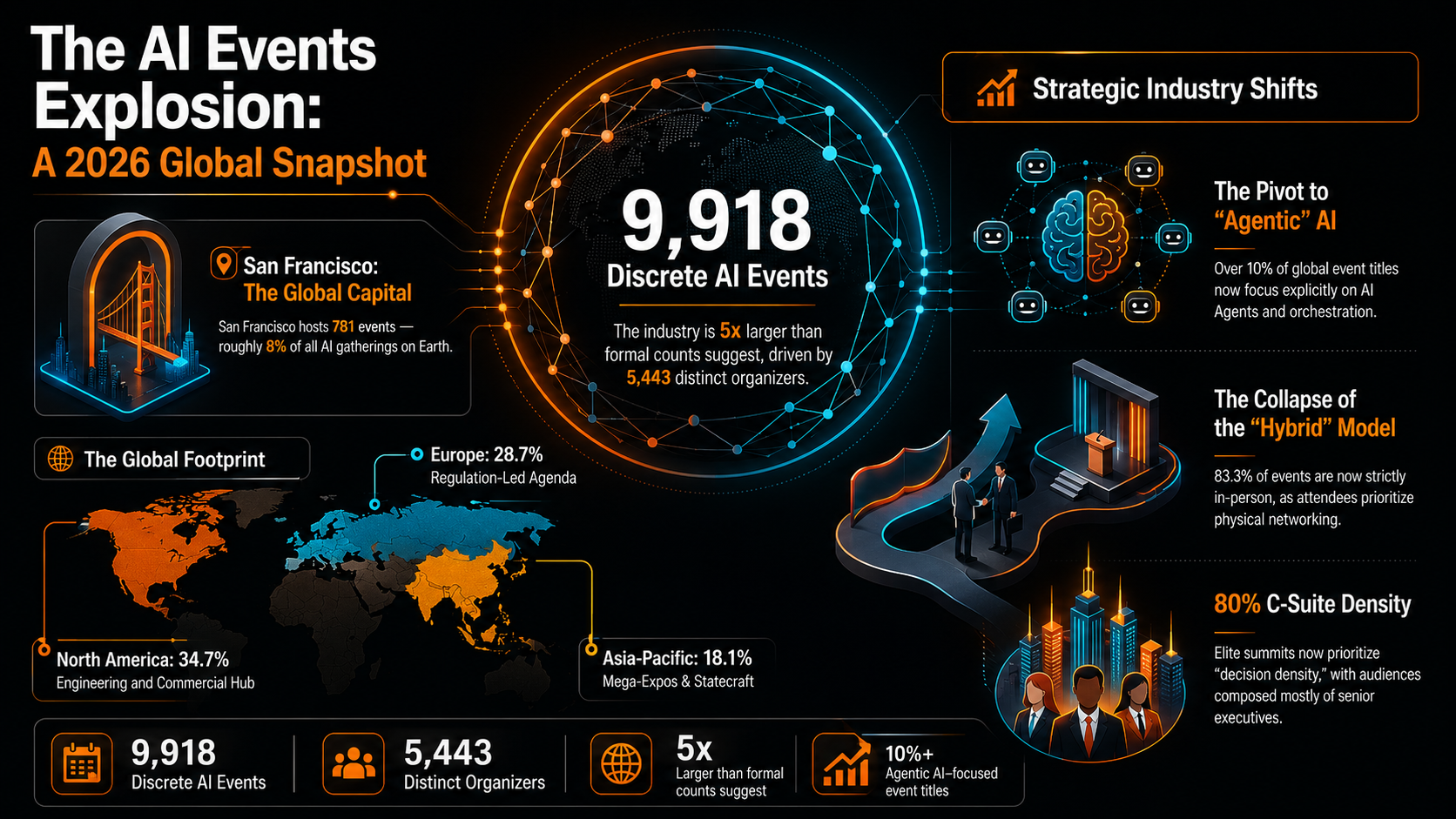
North America accounts for 34.7% of geographically resolved AI events, representing approximately 3,147 gatherings.
San Francisco alone hosts 781 events, close to 8% of the entire global dataset. But the region is not built around one city alone. Las Vegas specializes in commercial-scale conferences, San Jose leads hardware-focused convening, and Washington, D.C. serves as the policy hub.
North America also records one of the strongest agentic-AI pivots: 11.3% of event titles now reference agents or agentic systems.

Europe represents 28.7% of the global market, with approximately 2,600 scheduled AI events.
London leads the region with 458 events, followed by Paris, Berlin, and Amsterdam. However, Europe's defining feature is decentralization: more than 53% of European technology meetups take place outside the traditional top 20 hubs.
The EU AI Act, regulatory sandboxes, technical standards, and sovereign infrastructure are also creating an entirely new category of compliance and governance events.

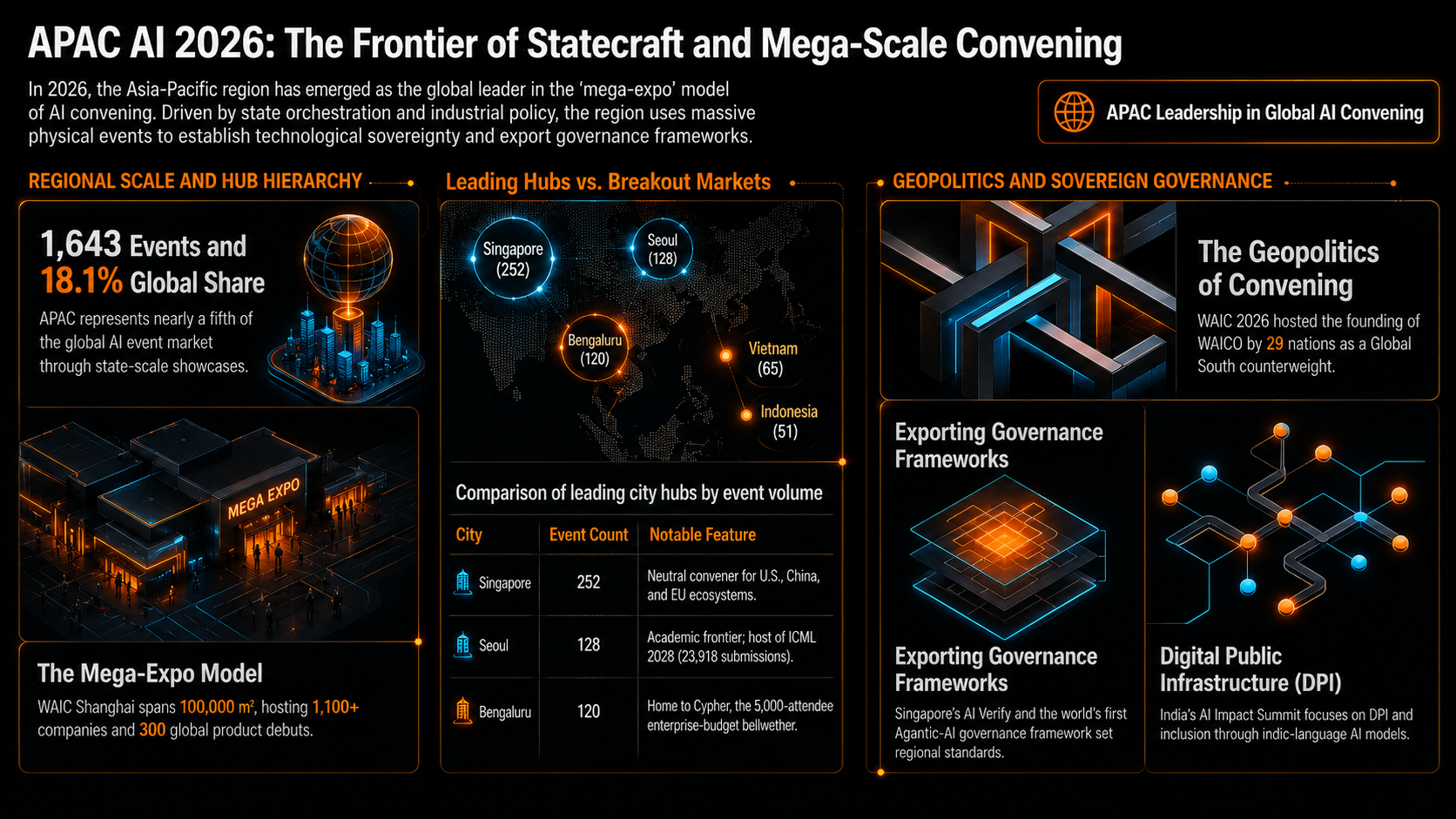
Asia-Pacific accounts for 18.1% of resolved events, or approximately 1,643 gatherings. Its influence, however, is much greater than event volume alone suggests.
The region is home to some of the world's largest AI showcases. WAIC Shanghai spans approximately 100,000 square metres, hosts more than 1,100 companies, and features hundreds of product launches.
Singapore leads the region's discoverable city-level activity with more than 250 events, while Seoul and Bengaluru combine academic depth with rapidly expanding enterprise ecosystems. Across APAC, events are increasingly used to promote sovereign AI infrastructure, governance frameworks, and national industrial policy.
Latin America represents a smaller 3.7% share of the global dataset, with 339 strategic AI events, but the region reached several major milestones in 2026.
ICLR's Rio de Janeiro edition attracted 9,954 attendees and almost 20,000 paper submissions, validating the region's ability to host a frontier research conference.
The launch of LatamGPT marked another turning point. Developed through a coalition of 65 institutions across 15 countries, the model was trained on 300 billion tokens of regional content, including indigenous-language material.

Africa's event ecosystem is being shaped by grassroots education, regional research networks, and a growing sovereign-AI agenda.
Data Science Nigeria's bootcamp illustrates the level of demand: approximately 32,000 applicants compete for 150 residential places, an admission rate of just 0.5%.
The Deep Learning Indaba has grown to more than 1,000 attendees from 47 countries, while Zindi connects approximately 80,000 practitioners across 52 African markets. At the policy level, 22 African countries have published national AI strategies, with another 21 reportedly in development.

Oceania presents one of the clearest examples of the market's shift toward vertical depth.
Australia hosts approximately 230 AI events, with cities developing distinct areas of specialization: Sydney in hyperscalers and safety, Melbourne in infrastructure, Canberra in government and defence, and Perth in mining AI.
While broad technology festivals have faced pressure, specialized AI summits continue to attract enterprise demand. That resilience is supported by a large adoption base: Australia has approximately 13.6 million active AI users, while AI-related productivity gains could contribute as much as NZ$102 billion annually to New Zealand's economy by 2038.

The industry is no longer defined only by large annual conferences. It now includes thousands of local meetups, technical workshops, academic gatherings, government forums, vendor ecosystems, and specialized executive summits.
Across regions, the themes differ. North America leads in engineering and commercialization. Europe connects regulation with industrial strategy. APAC uses convening as an instrument of statecraft. Latin America and Africa are building sovereign capabilities and talent pipelines. Oceania demonstrates the resilience of focused, high-value B2B formats.
Together, they show that AI events increasingly influence where capital moves, where technical standards emerge, where talent is discovered, and how countries position themselves in the global AI economy.